23 incredible new technologies you’ll see by 2021

Looking so close at the future. 

Related image

WHILE WE can’t really predict what the future holds.
We can look at how far we’ve come with technology in merely the last decade and realize the present we know now will, very soon, find itself memorialized in nostalgia. Here are some technologies on the horizon that are poised to change your life.
2012
Ultrabooks – The last two years have been all about the tablet. Laptops, with their “untouchable” screens, have yet to match any tablet’s featherweight portability and zippy response times. However, by next year, ultraportable notebooks — Ultrabooks — will finally be available for under $1000, bringing a complete computing experience into areas of life which, until now, have only been partially filled by smaller technologies such as tablets and smartphones. They weigh around three pounds, measure less than an inch thick, and the hard drives are flash-based, which means they’ll have no moving parts, delivering zippy-quick startups and load times.
The Mars Science Laboratory – By August 2012, the next mission to Mars will reach the Martian surface with a new rover named Curiosity focusing on whether Mars could ever have supported life, and whether it might be able to in the future. Curiosity will be more than 5 times larger than the previous Mars rover, and the mission will cost around $2.3 billion — or just about one and a half New Yankee Stadiums.

The Brain Cap, from U of Maryland.
The paralyzed will walk. But, perhaps not in the way that you’d imagine. Using a machine-brain interface, researchers are making it possible for otherwise paralyzed humans to control neuroprostheses — essentially mechanical limbs that respond to human thought — allowing them to walk and regain bodily control. The same systems are also being developed for the military, which one can only assume means this project won’t flounder due to a lack of funding.
2013
The Rise of Electronic Paper – Right now, e-paper is pretty much only used in e-readers like the Kindle, but it’s something researchers everywhere are eager to expand upon. Full-color video integration is the obvious next step, and as tablet prices fall, it’s likely newspapers will soon be fully eradicated from their current form. The good news: less deforestation, and more user control over your sources.
4G will be the new standard in cell phone networks. What this means: your phone will download data about as fast as your home computer can. While you’ve probably seen lots of 4G banter from the big cell providers, it’s not very widely available in most phones. However, both Verizon and the EU intend to do away with 3G entirely by 2013, which will essentially bring broadband-level speeds to wireless devices on cell networks. It won’t do away with standard internet providers, but it will bring “worldwide WiFi” capabilities to anyone with a 4G data plan.
The Eye of Gaia, a billion-pixel telescope will be sent into space this year to begin photographing and mapping the universe on a scale that was recently impossible. With the human eye, one can see several thousand stars on a clear night; Gaia will observe more than a billion over the course of its mission — about 1% of all the stars in the Milky Way. As well, it will look far beyond our own galaxy, even as far as the end of the (observable) universe.
2014
A 1 Terabyte SD Memory Card probably seems like an impossibly unnecessary technological investment. Many computers still don’t come with that much memory, much less SD memory cards that fit in your digital camera. Yet thanks to Moore’s Lawwe can expect that the 1TB SD card will become commonplace in 2014, and increasingly necessary given the much larger swaths of data and information that we’re constantly exchanging every day (thanks to technologies like memristors and our increasing ever-connectedness). The only disruptive factor here could be the rise of cloud-computing, but as data and transfer speeds continue to rise, it’s inevitable that we’ll need a physical place to store our digital stuff.
The first around-the-world flight by a solar-powered plane will be accomplished by now, bringing truly clean energy to air transportation for the first time. Consumer models are still far down the road, but you don’t need to let your imagination wander too far to figure out that this is definitely a game-changer. Consider this: it took humans quite a few milennia to figure out how to fly; and only a fraction of that time to do it with solar power.

The Solar Impulse, to be flown around the world. Photo by Stephanie Booth
The world’s most advanced polar icebreaker is currently being developed as a part of the EU’s scientific development goals and is scheduled to launch in 2014. As global average temperatures continue to climb, an understanding and diligence to the polar regions will be essential to monitoring the rapidly changing climates — and this icebreaker will be up to the task.
$100 personal DNA sequencing is what’s being promised by a company called BioNanomatrix, which the company founder Han Cao has made possible through his invention of the ‘nanofluidic chip.’ What this means: by being able to cheaply sequence your individual genome, a doctor could biopsy a tumor, sequence the DNA, and use that information to determine a prognosis and prescribe treatment for less than the cost of a modern-day x-ray. And by specifically inspecting the cancer’s DNA, treatment can be applied with far more specific — and effective — accuracy.
2015
The world’s first zero-carbon, sustainable city in the form of Masdar City will be initially completed just outside of Abu Dhabi. The city will derive power solely from solar and other renewable resources, offer homes to more than 50,000 people.
Personal 3D Printing is currently reserved for those with extremely large bank accounts or equally large understandings about 3D printing; but by 2015, printing in three dimensions (essentially personal manufacturing) will become a common practice in the household and in schools. Current affordable solutions include do-it-yourself kits like Makerbot, but in four years it should look more like a compact version of the uPrint. Eventually, this technology could lead to technologies such as nanofabricators and matter replicators — but not for at least a few decades.
2016
Space tourism will hit the mainstream. Well, sorta. Right now it costs around $20-30 million to blast off and chill at the International Space Station, or $200,000 for a sub-orbital spaceflight from Virgin Galactic. But the market is growing faster than most realize: within five years, companies like Space Island, Galactic Suite, and Orbital Technologies may realize their company missions, with space tourism packages ranging from $10,000 up-and-backs to $1 million five-night stays in an orbiting hotel suite.
The sunscreen pill will hit the market, protecting the skin as well as the eyes from UV rays. By reverse-engineering the way coral reefs shield themselves from the sun, scientists are very optimistic about the possibility, much to the dismay of sunscreen producers everywhere.
A Woolly Mammoth will be reborn among other now-extinct animals in 2016, assuming all goes according to the current plans of Japan’s Riken Center for Developmental Biology. If they can pull it off, expect long lines at Animal Kingdom.
2017
Portable laser pens that can seal wounds – Imagine you’re hiking fifty miles from the nearest human, and you slip, busting your knee wide open, gushing blood. Today, you might stand a chance of some serious blood loss — but in less than a decade you might be carrying a portable laser pen capable of sealing you back up Wolverine-style.
2018
Light Peak technology, a method of super-high-data-transfer, will enable more than 100 Gigabytes per second — and eventually whole terabytes per second — within everyday consumer electronics. This enables the copying of entire hard drives in a matter of seconds, although by this time the standard hard drive is probably well over 2TB.
Insect-sized robot spies aren’t far off from becoming a reality, with the military currently hard at work to bring Mission Impossible-sized tech to the espionage playground. Secret weapon: immune to bug spray.
2019
The average PC has the power of the human brain. According to Ray Kurzweil, who has a better grip on the future than probably anyone else, the Law of Accelerating Returns will usher in an exponentially greater amount of computing power than ever before.

The Web Within Us. Image by Anna Lena Schiller.
Web 3.0 – What will it look like? Is it already here? It’s always difficult to tell just where we stand in terms of technological chronology. But if we assume that Web 1.0 was based only upon hyperlinks, and Web 2.0 is based on the social, person-to-person sharing of links, then Web 3.0 uses a combination of socially-sourced information, curated by a highly refined, personalizable algorithm (“they” call it the Semantic Web). We’re already in the midst of it, but it’s still far from its full potential.
Energy from a fusion reactor has always seemed just out of reach. It’s essentially the process of producing infinite energy from a tiny amount of resources, but it requires a machine that can contain a reaction that occurs at over 125,000,000 degrees. However, right now in southern France, the fusion reactor of the future is being built to power up by 2019, with estimates of full-scale fusion power available by 2030.
2020
Crash-proof cars have been promised by Volvo, to be made possible by using radar, sonar, and driver alert systems. Considering automobile crashes kill over 30,000 people in the U.S. per year, this is definitely a welcome technology.
2021
So, what should we expect in 2021? Well, 10 years ago, what did you expect to see now? Did you expect the word “Friend” to become a verb? Did you expect your twelve-year-old brother to stay up texting until 2am? Did you expect 140-character messaging systems enabling widespread revolutions against decades-old dictatorial regimes?
The next 10 years will be an era of unprecedented connectivity; this much we know. It will build upon the social networks, both real and virtual, that we’ve all played a role in constructing, bringing ideas together that would have otherwise remained distant, unknown strangers. Without twitter and a steady drip of mainstream media, would we have ever so strongly felt the presence of the Arab Spring? What laughs, gasps, or loves, however fleeting, would have been lost if not for Chatroulette? Keeping in mind that as our connections grow wider and more intimate, so too will the frequency of our connectedness, and as such, your own understanding of just what kinds of relationships are possible will be stretched and revolutionized as much as any piece of hardware.
Truly, the biggest changes we’ll face will not come in the form of any visible technology; the changes that matter most, as they always have, will occur in those places we know best but can never quite see: our own hearts and minds. 
* Brought to you in partnership between Matador and our friends at Intel, whose technology enables so much of the lifestyle in which we thrive. Join us in the conversation on Twitter with #IntelEMP.
* This post was originally published on October 17, 2011. brought to you by jaaf blog 2018. 

Nokia 9 PureView’s Eye-Catching Penta Camera Setup Surfaces Again

At this point in time, we’ve seen tons of Nokia 9 PureView leaks showing the phone’s Penta camera design, and some new images have just surfaced, reaffirming what we’ve seen thus far. If you take a look at the gallery down below, you will be able to see four images showing off the Nokia 9 PureView’s cameras, and a third-party case in a couple of color variants. This is almost not an official case for the device, rather a third-party one that will be available via eBay, AliExpress, and similar shopping websites. The case itself seems to be made out of silicone, and it has some sort of texture on the back, for a better grip. We’ve seen cases similar to this one, for other devices, and it seems like the case is already ready for the Nokia 9 PureView as well. Having said that, the most important part of this leak is the design of the phone’s cameras, of course, it’s difficult not to notice those seven rings on the back, five of which are reserved for the phone’s cameras. The sixth and seventh rings are there for an LED flash and some sort of a dual sensor. Top-left and top-right rings are not there for cameras, but all the other ones are. This leak does not exactly reveal the phone’s design, at least not in full, but we’ve already seen the Nokia 9 PureView plenty of times, so there’s nothing left to hide at this point, at least it seems like it.
Five Cameras, Glass Build, And No Notch Or Punch-Hole
The Nokia 9 PureView will be considerably different than other 2019 flagships, at least in terms of the design. It seems like most OEMs are planning to introduce flagships with either notches or display holes, well, HMD Global plans to take the other route, and include slightly thicker bezels on the top and bottom, instead of including a notch or a display hole. Many people would agree that this is the better choice, as notches are not exactly loved by users, and display holes are even worse, at least in my opinion. Having display holes is basically like having huge dead pixels on the display, and unlike notches, you cannot exactly hide those display holes, so I do hope that we’ll still see flagships like the Nokia 9 PureView in 2019, a flagship does is not tainted with a display hole(s).
The phone itself will be made out of metal and glass, while those cameras on the back will be easily recognizable compared to other devices, that’s for sure. As far as cameras themselves are concerned, we’re not exactly sure what sensors to expect on the device, but we’ll probably see both telephoto and wide-angle cameras on the back of the phone, and quite possibly even a monochrome lens. PureView technology is a mystery at the moment, as it has been quite a few years since we’ve last seen its implementation, and the technology has probably evolved quite a bit since then, so it remains to be seen what will it have to offer this time around, and will it be able to stand side-by-side with other flagship smartphone cameras in the market.
High-End Phone, High-End Specs?
There’s a good reason why there’s a question mark at the end of this title, it’s because we’re still not sure if the Nokia 9 PureView will include the Snapdragon 845 or 855. The device was originally supposed to ship with the Snapdragon 845 back in September, but the phone got delayed several times since then, and the Snapdragon 855 became official in the meantime. Pretty much every major non-Huawei and non-Apple flagship that arrives in 2019 will be fueled by the Snapdragon 855, so HMD Global should definitely include that chip in the Nokia 9 PureView, otherwise the phone may suffer the same fate as the Nokia 8 Sirocco. The Nokia 8 Sirocco launched at MWC 2018 with the Snapdragon 835, while other OEMs were introducing phones with the Snapdragon 845, and needless to say, the phone’s sales were not all that good. The Nokia 9 PureView may suffer if HMD Global opts for the Snapdragon 845, but we’ll see. The phone is also expected to include 6GB / 8GB of RAM, and ship with Android 9 Pie. A large display is expected to be a part of the offering, a display of at least 6 inches, while the phone is also expected to include a large battery on the inside.

Mercedes-Benz 2018 Auto Expo Showcase

Image result for Mercedes-Benz 2018 Auto Expo Showcase

India’s largest luxury car maker Mercedes-Benz is all set to excite, fascinate and enthral at the 14th Edition of the much awaited ‘Auto Expo 2018.’ The German automaker will showcase an array of some of the never seen before products in India, which will dazzle at the company’s Pavilion at Hall No. 15. The key highlight of Mercedes-Benz’s product lineup will be based on three distinct product attributes: Luxury, Versatility and Future Mobility. Making its much awaited India debut is the Mercedes-Maybach S 650 sedan. Its an amalgamation of the perfection of the S-Class and the exclusivity of the Maybach. 
#MercedesBenz #MercedesBenzAutoExpo2018 #2018AutoExpo #DelhiAutoExpo #MercedesBenzNewLaunches #MercedesBenz2018 

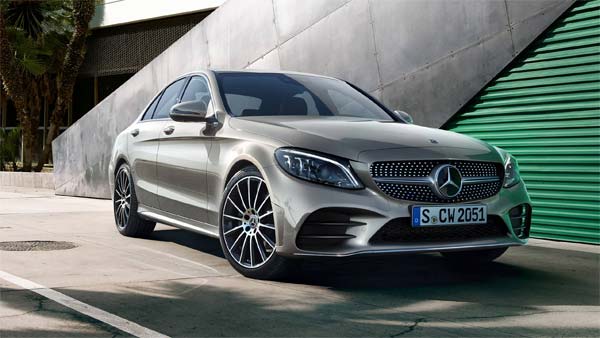
2018 Mercedes-Benz C-Class Petrol Variant Launched In India

Priced At Rs 43.46 Lakh 

2018 Mercedes-Benz C-Class Petrol Variant Launched In India: Price & Specification Details

Mercedes-Benz India has silently introduced the petrol variant of their 2018 C-Class sedan. The 2018 Mercedes-Benz C-Class was launched initially in September, however, it was available only in the diesel format. The new Mercedes-Benz C-Class petrol variant comes with a price tag of Rs 43.46 lakh, ex-showroom (India). The C-Class C200 Progressive variant sits between the lower C220d Prime and C220d Progressive diesel variants.

2018 Mercedes-Benz C-Class Petrol Variant Launched In India: Price & Specification Details

With the addition of the new petrol variant, the 2018 Mercedes-Benz C-Class is now available in a total of four variants; three diesel and one petrol. The three diesel variants include — C220d Prime, C220d Progressive and C300d AMG Line. 

2018 Mercedes-Benz C-Class Petrol Variant Launched In India: Price & Specification Details

The diesel variants come with a starting price of Rs 40 lakh for the C220d Prime trim while the top-spec C300d AMG Line has a price tag of Rs 48.50 Lakh. All prices are ex-showroom (India). The 2018 Mercedes-Benz C-Class petrol variant comes powered by a 1.5-litre four-cylinder engine. It produces 180bhp and 280Nm of peak torque. The engine is also mated to a mild-hybrid powertrain, which provides an additional 10bhp and 160Nm of torque. This powertrain is further mated to a standard nine-speed automatic gearbox. In terms of features, the C-Class petrol variant carries most of the equipment seen on the diesel variants. 

2018 Mercedes-Benz C-Class Petrol Variant Launched In India: Price & Specification Details

This includes multi-function steering wheel, dual touchpad control, 10.25-inch COMAND infotainment system, panoramic sunroof, active parking assist, ambient lighting with 64 colour options and a range of other safety and driver assist features. 

Thoughts On
The 2018 Mercedes-Benz C-Class Petrol 
Variant Mercedes-Benz
launched the 2018 C-Class 
back in September. 

Initially, the C-Class was available in just the diesel format, however, Mercedes-Benz has now introduced the petrol variant as well. In India, the Mercedes-Benz C-Class rivals the likes of the BMW 3-Series and the Audi A4.

Stocks To Buy Ahead of General Elections 2019

Stocks To Buy Ahead of General Elections 2019
Nobody wants to try and predict the outcome of the General Elections scheduled for May 2019. Even noted Yoga guru, Baba Ramdev recently said, “We can’t say who will become the next prime minister (after the 2019 general elections).”
The Congress party dislodged the BJP from the three states of Rajasthan, Chattisgarh and Madhya Pradesh, in the recent assembly elections, raising the prospects of a hung verdict in 2019.
Markets are hence likely to be very volatile and investors should focus on a few good quality stocks ahead of the general elections. Here are a few defensive stocks that can have limited downside risk.
Shares of Coal India are a good and less risky bet. The company barely faces any business risk and has been declaring dividends, which give you yields that are as good as bank deposits, post tax.
This year one can expect a total dividend of at least Rs 19 to Rs 20 per share. It has already declared a dividend of Rs 7.25 per share. If you buy the shares now, you could get some more dividend in Feb. Assume that you buy the shares at Rs 250, your dividend yield could work as high as 7.5 per cent to 8 per cent every year.
Dividends again are tax free, to the extent of Rs 10 lakhs per year. The company’s profitability has been increasing over the last few quarters. The stock is also trading at a p/e of just 9 times one year forward earnings, which makes it an interesting bet.
In fact, for the quarter ending Sept 30, 2018 the company reported a sharp jump in profits. The net profits saw a rise of over eight-fold to Rs 3,085 crore for the quarter to September 2018 compared to a net profit of Rs 370.4 crore in the corresponding quarter of previous fiscal.
 

The shares are trading at a p/e of just 8 times one year forward earnings, which makes the stock a good long term bet.
Jammu and Kashmir Bank
This is one stock that has been consistently falling over the last few weeks. At a price of Rs 36, the stock barely poses any risk. The asset quality of the bank has improved marginally over the last few quarters. We believe that it would continue to remain so, as the bank focuses on recovery. One can also see an improvement in profitability in the current financial year, when compared to the previous year.
J&K Bank, reported a 44% increase in its net profit to Rs 146.34 crores for the half year ended September 30, 2018. The Bank had posted a net profit of Rs 101 crores during the first half of previous fiscal.
The stock is actually trading at a p/e of just 8 times one year forward earnings. A good stock to buy at the current levels. The price to book value of the stock is a mere 0.37 times. With slippages at the bank likely to fall, there is a high possibility that we could see the stock rally. J&K Bank also has a very small equity base and any improvement in the profits can send the stock soaring.

Top Technology Stories of 2018

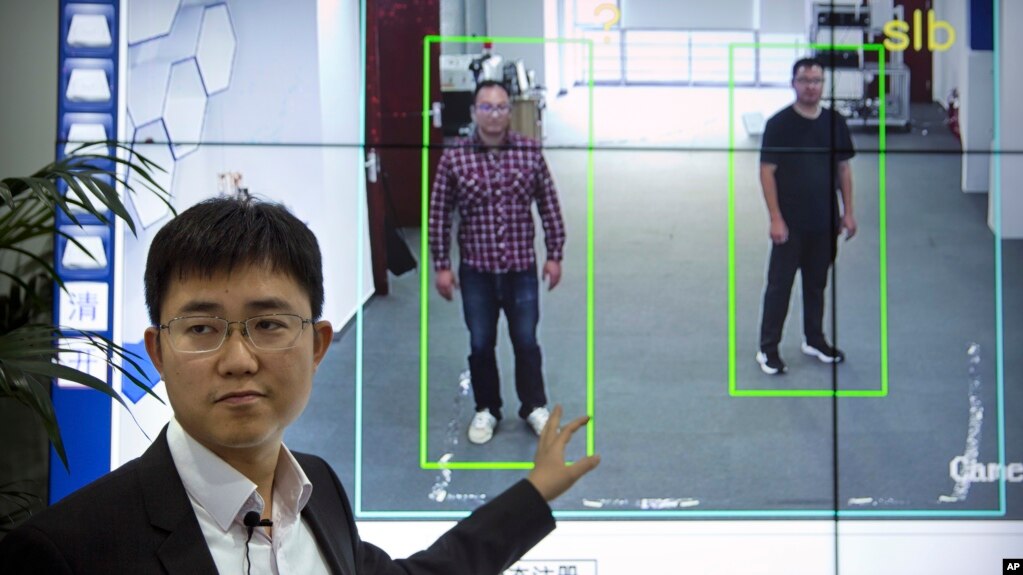
In this Oct. 31, 2018, photo, Huang Yongzhen, CEO of Watrix, demonstrates the use of his firm's gait recognition software at his company's offices in Beijing.
During 2018, we reported on many inventions and new technologies aimed at making machines smarter. We also covered stories on how some technologies threaten user privacy.
Artificial intelligence
There was a lot of news related to artificial intelligence, or AI, and machine learning. Among the stories were two dealing with direct competitions between humans and machines.
In one competition, machines that used AI performed better than human beings in a high-level reading test. Two natural language processing tools beat human results in the experiment. One of the tools was built by the American technology company Microsoft. The other was created by Chinese online seller Alibaba Group.
In another competition, a computer took on humans in live, public debates. The event demonstrated how AI-powered computers are increasingly being developed to think and sound like humans.
Noa Ovadia, left, and Dan Zafrir, right, prepare for their debate against the IBM Project Debater, Monday, June 18, 2018, in San Francisco. (AP Photo/Eric Risberg)

Noa Ovadia, left, and Dan Zafrir, right, prepare for their debate against the IBM Project Debater, Monday, June 18, 2018, in San Francisco. (AP Photo/Eric Risberg)
The organizer of the debates, U.S. technology company IBM, announced split results. It said a majority of those watching said they felt the machine had done more to improve their knowledge of the subject. But, the human got more praise for communicating her ideas.
This year, we also explored the many ways AI and machine learning are now being used. For example, some U.S. judges use machine learning systems to help them decide when, and for how long, criminals should be jailed. The system uses computers to examine data from thousands of court cases. The computer then predicts whether a defendant will commit a new crime or fail to return to court.
In this Aug. 30, 2017, photo, Stephanie Pope-Earley, right, sorts through defendant files scored with risk-assessment software for Jimmy Jackson Jr., a municipal court judge, on the first day of the software's use in Cleveland. (AP Photo/Dake Kang)

In this Aug. 30, 2017, photo, Stephanie Pope-Earley, right, sorts through defendant files scored with risk-assessment software for Jimmy Jackson Jr., a municipal court judge, on the first day of the software’s use in Cleveland. (AP Photo/Dake Kang)
One fast-growing area of AI is facial recognition, which is increasingly being used for security purposes.
Recently, Atlanta’s Hartsfield-Jackson airport became the first in the U.S. to permit passengers to use facial recognition technology to get on flights. A Chinese company showed off an AI system it developed to recognize individuals by body shape and walking movements. The system is already being used by Chinese police in Beijing and Shanghai.
In addition, machine learning was used during 2018 to predict results of the World Cup soccer competition. The technology also created artwork that sold for a large amount of money. And it is being used to help farmer save time and money, while reducing environment-harming chemicals. Other technology systems are being used to follow farm animals and wildlife to collect information on their activities.
In this file photo, ecoRobotix demonstrates its 'smart farm' technology, which uses artificial intelligence to identify weeds and precisely deliver herbicide to kill them. (ecoRobotix)

In this file photo, ecoRobotix demonstrates its ‘smart farm’ technology, which uses artificial intelligence to identify weeds and precisely deliver herbicide to kill them. (ecoRobotix)
Privacy issues
Facebook received intense criticism this year. The company’s chief Mark Zuckerberg was asked to testify before the U.S. Congress about a major leak of private user information. Zuckerberg admitted the company made mistakes that led to private data being shared with a British research company. Lawmakers demanded that the social media service take steps to protect user privacy and proposed legislation to prevent other incidents.
Google also faced questions about its privacy policies after an investigation by the Associated Press (AP). AP found that Google was continuing to collect location information on users, even when users had changed their privacy settings.
Facebook CEO Mark Zuckerberg arrives to testify before a House Energy and Commerce hearing on Capitol Hill in Washington, Wednesday, April 11, 2018. (AP Photo/Andrew Harnik)

Facebook CEO Mark Zuckerberg arrives to testify before a House Energy and Commerce hearing on Capitol Hill in Washington, Wednesday, April 11, 2018. (AP Photo/Andrew Harnik)
Google said users can stop the collection of all location markers at any time by turning off a specific privacy setting. But independent researchers told the AP that setting was not clearly identified by Google as being connected to location information.
Transportation tech
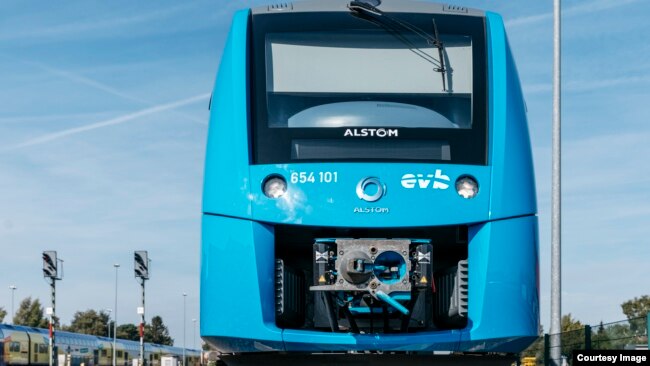
The new Coradia iLint hydrogen-powered train, recently launched as the first of its kind in the world, is seen on the tracks in northern Germany. (René Frampe/Alstom)
After several accidents involving self-driving test vehicles, we examined ethical questions about the technology. An expert on the subject, Nicholas Evans, told VOA that he is studying ways to get driverless vehicles to make ethical decisions. In many driving situations, vehicles will be expected to quickly consider levels of risk before deciding how to act.
A new study found that some driver assistance systems fail to perform some actions in tests. The study was carried out by the American Automobile Association of America. Part of the study found that about 40 percent of people questioned believed the driver assist systems could drive a car by themselves. The organization warned of the dangers of such misinformation.

The new Coradia iLint hydrogen-powered train, recently launched as the first of its kind in the world, is seen on the tracks in northern Germany. (René Frampe/Alstom)
In Sweden, a new technology was developed to create the world’s first operating electrified road. The system is designed to charge an electric vehicle’s battery as it travels.
And in Germany, officials celebrated the launch of the world’s first operating hydrogen-powered trains. The new train model is part of efforts in Europe and other places to move away from polluting diesel trains.
I’m Bryan Lynn.
Bryan Lynn wrote this story for VOA Learning English. Mario Ritter Jr. was the editor.
What were your favorite technology stories from 2018? Write to us in the Comments section,

Motorola One Power latest update improves system stability

Motorola One Power latest update
Motorola One Power latest update improves system stability

The year 2018 is almost about to end and we have seen a plethora of launches this year when it comes to smartphones. While the smartphone manufacturers are done for the release for this year, they have now started pushing pout updated for their devices to improve their performance along with the user overall user experience.

The American smartphone manufacturer Motorola had also released a bunch of smartphones this year and has also released timely updates for most of them. One of such Motorola smartphones is the Motorola One Power. Launched back in October the smartphone comes with Android 8.1 Oreo out-of-the-box and has already received an Android Pie update back in November. Well, it appears that the company is not just done yet and has pushed out a new update for the Motorola One Power smartphone. 

The Android One powered smartphone offers decent built quality and impressive performance. 

The new update which the smartphone is receiving is said to be the December 2018 Android Security patch and it brings along certain tweaks along with it. 
The update improves overall system stability for enhanced user experience. The update also improves the call quality and network stability on the device. 

Motorola One Power specifications and features: The mid-range Android One fuelled Motorola One Power uses a Snapdragon 636 chipset clocked at 1.8GHz under its hood. The processor is paired with Adreno 509 GPU to render all the graphics intensive tasks along with 4GB of RAM for multitasking. In terms of storage, the device offers 64GB of internal storage which is expandable up to 128GB via microSD card. 

The device ships with Android 8.1 Oreo, however, it has received the latest Android Pie update. Motorola One Power adorns a 6.2-inch IPS LCD display panel with 1080 x 2246 pixels screen resolution. The imaging capabilities of the device include a dual-lens rear camera module comprising of a 16MP primary and a 5MP secondary sensor. 

Up front, there is a 12MP camera for selfies. Backing up the unit is a massive 5,000mAh battery unit which lasts for more than a day on a single charge.

Apple to begin assembling top-end Apple iPhones in India in 2019

Why “Make In India”?

Apple to begin assembling top-end Apple iPhones in India in 2019


Apple currently manufactures entry-level iPhones like the Apple iPhone SE and Apple iPhone 6s in India. According to a report from  Reuters, the company is planning to start full-scale premium Apple iPhone manufacturing in India beginning in 2019.

Apple in collaboration with Foxconn is planning to set up a new manufacturing plant in Tamil Nadu to assemble high-end iPhones like the Apple iPhone XR, Apple iPhone XS, and Apple iPhone XS Max. According to Tamil Nadu Industries Minister MC Sampath, Apple will be investing $356 million (about Rs 2,500 crores) for the initial setup of the iPhone production factory in Tamil Nadu, which is expected to create 25,000 jobs. Why “Make In India”?

 The Apple iPhones are priced higher than most of the other premium smartphones from brands like Samsung, Huawei, LG, and even Sony. In fact, the Apple iPhones cost more the US or Dubai pricing. One reason for the inflation of the Apple iPhone prices in India is the import duty, Govt of India levy a whopping 20% import duty, which will increase the overall price of the iPhones. The “Made In India” iPhones are expected to cost at least 5 to 10,000 less than the iPhones imported from China, which will drive down the price of the smartphone.

 The base variant of the Apple iPhone XR costs Rs 74,900, whereas the iPhone XS Max with 512 GB internal storage costs Rs 1,44,900, which makes it one of the most expensive smartphones. Even with the “Made In India” emblem, the above-mentioned iPhones might receive a marginal price cut, but they will not be affordable in any way, and Apple will continue to sell its product in the premium segment. Soon we will be able to see “Made In India” logo on the more expensive iPhone modes like the Apple iPhone X, iPhone XR, iPhone XS, and iPhone XS Max.

£17,000 MacCaLM (Credit and Labor Market Foundations of the Macroeconomy) Studentships

Huawei might launch P30 lineup of smartphones at MWC 2019

Huawei might launch P30 lineup of smartphones at MWC 2019

Huawei might launch P30 lineup of smartphones at MWC 2019

The Chinese tech giant Huawei has released some impressive handsets this year with the most recent being the Huawei Nova 4 that has an in-display hole for the selfie camera. As the year 2019 is approaching the company is also gearing up for its next major release. Huawei is expected to bring the successor of its quite well received P20 series of smartphones, i.e, the Huawei P30 lineup.

The Huawei P30 series which comprises of the P30 and the P30 Pro have appeared over the web in various leaks and rumors and it was tipped that the device will hit the shelves next year in 2019. While there was nothing concrete available about the device’s availability, some recent findings reveal that Huawei will release these smartphones during the MWC 2019. The MWC 2019 is taking place in Barcelona next year from February 25 to February 28. Besides, Huawei is also expected to introduce IoT solutions and 5G technology during the MWC 2018. The P30 lineup will carry forward the triple camera setup design at the rear panel. The P30 Pro might get an additional sensor at the back, whereas, the standard P30 variant will get the usual triple lens setup as the P20 lineup. The display on both the smartphones will have a teardrop notch design. If we talk about the some other leaked specifications then the Huawei P30 series will sport a 24MP sensor up front to capture selfies and for video calling. The device might also incorporate an in-display fingerprint scanner to unlock the device. Under the hood, the Huawei P30 series will be backed by the flagship Kirin chipset which could be the Kirin 980 or Kirin 990. Though, it would be interesting to see which chipset the company uses to power its next flagship smartphone. The Huawei P30 series will ship with Android 9.0 Pie out-of-the-box with company’s own EMUI 9.0 skin on top of it.

Create your own website, free on WordPress.com.Create your own website.
Start free